Tuesday, 16 June 2015

HUMANS review: 9pm Channel 4, Sundays

THE ALMOST PEOPLE
In the new drama series Humans, Channel 4's mix of the domestic and science fiction conspiracy is a must-see.

Part of Channel 4's ingenious marketing campaign. (Image: Channel 4)


This new drama has a commendably simple premise: technology is now so advanced that it looks like real people. This concept is laid out in a wonderfully evocative opening scene in which semi-naked ‘Synths’ – artificial human servants – stand in uniform lines in a warehouse. Neatly indicating that something has gone disturbingly awry with the Synth production line, one of them breaks ranks by raising its head to look at the moon.


A first episode by its very nature has to introduce the series’ scenario and characters, and the first part of Humans was particularly impressive as it covered A LOT of ground in under an hour. The four concurrent and related plots moved deftly from family tension to global conspiracy: the overworked and dysfunctional Hawkins family acquired a female Synth, ‘Anita’ (Gemma Chan), capable of the heresy of independent thought; five weeks in the future, an escape route for Synths run by Leo (Colin Morgan) includes Anita, who he’s in love with; a man called Hobb (DannyWebb) heads a covert unit hunting Synths who have learned to lie and change their names while, in the fourth plot line, an old man called George Millican (a movingly restrained William Hurt) refuses to trade up his defective, young male Synth for a newer model, treating the machine like a son he can’t let go of.


That’s the real genius of this series: with technology that looks human, the writers Sam Vincent and Jonathan Brackley are able to invoke skewed takes on familiar situations. In a conventional drama series, Anita would be the attractive, sly home help with designs on luring Joe (the always believable Tim Goodman-Hill) away from his overworked and often absent career wife Laura (Katharine Parkinson). That’s also the case here, but it’s set up through the suggestive promise of the ‘adult options’ software that the Synth salesman palms to Joe with a wink, and, chillingly, the way Anita bonds with Laura’s children. The youngest Sophie (Pixie Davies) claims that the Synth ‘doesn’t rush’ her bedtime reading, a comment that speaks volumes about the child’s relationship with her busy mother and is typical of the sharp, focused economy of the writing. In a drama about a lonely old man, Muillican’s Synth would be an ageing dog going feral that needs to be put down – and is discussed in similar terms here – but in Humans this situation is given an extra, unnerving dimension because Millican treats his faltering companion by treating it as if it is human.


The idea is sold by the actors playing the Synths, who are all exceptional. Their still expressions, unquestioning compliance with human requests and occasional dialogue like a malfunctioning computer is a clever way of reinforcing that these facsimiles look real but aren’t, as are their luminescent eyes (reminiscent of those other alien interlopers in human form, in the film Village of the Damned). It’s even more unsettling when the self-aware Synths develop personalities and human body language as – apart from their eyes – they can’t be told apart at all.


This is what’s worrying Hobbs. Talk of the ‘Asimov blocks’ the Synths have, which means they can never harm humans, is an inevitable reference to the robot stories of the science fiction visionary and writer Isaac Asimov, who’s First Law of robotics stated that no robot could ever hurt people. With the Synth population on the verge of outnumbering the human one and some of them going rogue, the ‘big’ story in Humans suggests that mankind’s time may be up. This part of the set-up is, it has to be said, a hackneyed sci-fi idea, having been featured in everything from Blade Runner to Doctor Who, but Humans skill is that it uses the recognisably domestic to symbolise the story’s wider implications and, so far, this part of the series is the most compelling.


It was the same with Humans’ marketing campaign. Over the last few weeks, an advert for Synths appeared in the commercial breaks in and between programmes on Channel 4. It speaks volumes that I didn’t automatically dismiss the bogus ad as a stunt. ‘Really?’ I remember thinking. ‘Surely not…’ The near-possibility of synthetic, servile humans is what makes Humans the most compelling piece of sci-fi to have come along in some time.


Gotta make way for the homo superior? We shall see.

Thursday, 4 June 2015

CALLAN UNCOVERED 2 review

WHERE ELSE COULD I GO?
VOLUME 2, MR CALLAN

Terse talking and tough acting secret agent David Callan is back, in a second omnibus of short stories even better than the first.

The man who walks alone... Edward Woodward as Callan (Image: ITV)


Last year, for the first time, Ostara published over 20 short stories by James Mitchell featuring his troubled British intelligence executioner, David Callan, that were printed in the TV Times and Sunday Express over forty years ago. For enthusiasts of the TV series the tales were based on (which ran between 1967 and 1972), Callan Uncovered was quite a prize: although featuring on some websites in their original form, the stories had never been collated together before. (The bumper crop was topped and tailed with the – radically different – original synopsis for a TV episode and a script that was never made).


Together with Ostara editor Mike Ripley and several other dedicated fans, I’d found some of them. At 25, we thought that had to be it, but were delighted when another 15 surfaced, partly as the result of research for The Callan File: The Definitive Guide to the Classic Spy Franchise. A second Callan omnibus was a given, this time enlarged by two scripts for the TV series that no longer exist in the ITV archive.


Volume 2 is the more fascinating, as it chronicles the beginning of the Express short story range in 1970, when Callan had only been on television for two years and would continue for two more. The 1969 Callan novel A Magnum for Schneider had shown the character to be as at home on the page as the TV screen and, even if 1970’s five condensed thrillers show Mitchell finding his style in the short story format, they do deliver two classics every bit as bleak and brutal as the TV episodes.


File on a Faithful Husband finds Callan orchestrating the death of Dekker, a hit man deeply in love with his wife, who the British agent has planned to be found dead in a prostitute’s room, a scheme designed to humiliate Dekker in his final moments and emotionally destroy his wife. The story is extremely disturbing, particularly in the scene where the opposition killer begs Callan for mercy. File on a Loving Sister is equally and rewardingly downbeat. Ordered to form a romantic attachment with Enid Matthews, the sister of a traitor, so her brother Frank can be caught, Callan tragically falls for Enid, knowing their relationship will end when he engineers Frank’s capture. Even at this early stage in the range, Mitchell was delivering some typically earthy, eloquent prose that raised his Callan adventures well above the routine: ‘This girl needed love. She had given for too long.’


From File on a Chinese Hostess published in 1971 the stories had a bigger word count, allowing free reign to Mitchell’s innovative plotting, terse, laconic description and a Callan completely at one with his TV incarnation: tough, intelligent, bullying and unpleasant, tempered by a charismatic, dour harm. One of the highlights of the short stories – as in the TV series and novels – are the scenes between Callan and his petty thief, body odour-suffering contact ‘Lonely’. He has plenty of good moments here, from improbably acting as chauffer to an African diplomat to devouring a cordon bleu meal during a burglary.


This collection, written while Mitchell was still working on the TV series, is my favourite, as not only do the stories avoid being formulaic – unlike some written between 1973 and 1976 – but they accurately capture the ethical contradictions of Callan and the world he inhabits, as well as being shot through with mordant humour. File on a Willing Victim and File on a Deadly Doctor are two of the finest Callan stories in any medium, while File on a Gallic Charmer has one of the franchise’s funniest scenes. 


As Lonely would say: ‘Nice one, Mr Callan.’

Tuesday, 19 May 2015

JONATHAN STRANGE & MR NORRELL review, BBC1, Sunday 17 May 2015

STRANGE BREW
'Pull out your purses and procure some curses.' Sunday night TV just got weird and wonderful.

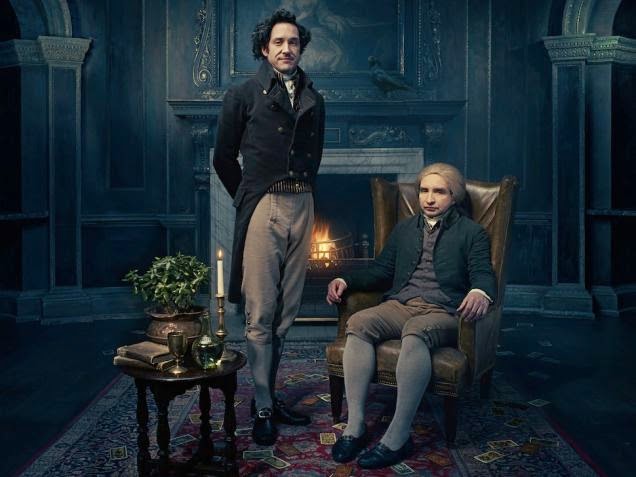
Mr Strange (Bertie Carvel) and Mr Norrell (Eddie Marsan). (Image: BBC)


Did you see the first part – or rather ‘chapter’, as the titles stylishly informed us – of Jonathan Strange & Mr Norrell, the BBC1 adaptation of Susanna Clarke’s modern Gothic novel? It was a truly wondrous thing.
If someone was telling you about it, you’d make a sceptical face and think the pitch for the series was unlikely fare for a primetime Sunday night TV drama. In the 19th century, two magicians (Bertie Carvel and Eddie Marsan, in the shoes of the eponymous pair) offer their skills to the British government in the war against Napoleon. Harry Potter meets Sharpe? Taxi for the writer please…
What’s so clever about the series is that, as it draws the audience into the familiar territory of a prestigious BBC costume drama, it treats magic as something real and historical, ‘as much part of this country as rain’ – a striking metaphor, suggestive of how literate and lyrical the dialogue and names are – so that you don’t question the authenticity of moving statues or revived corpses.
The story is a rich one. There’s the fascinating idea that magic is disreputable and not something that 19th century gentlemen, particularly those in the government, should be involved with. There’s also the very contemporary idea that once magic is presented to the fashionable houses of the great and good (the 19th century equivalent of Twitter), it will be restored to its rightful stature at the heart of the nation.
As well as all this intrigue and period detail, Jonathan Strange & Mr Norrell demands your patience, tantalising you with exotic hints of a dark, developing story – the coming of an ominous presence called the Raven, the identity of a spectral apparition called The Gentleman (a spellbindingly sinister Marc Warren), why magic suddenly stopped being practised 300 years ago – confident that viewers will take to this carefully constructed, quirky alternative England.

The takeover of a Sunday night audience pining for Ross Poldark’s reassuring pectorals is completed by the casting. The look of the series may owe a lot to the work of the artist William Hogarth, who had a taste for the grotesque, but the acting and characterisation is vintage BBC Dickens. Strange himself is bumbling, a drinker, potentially raffish but well-meaning, endearingly brought to life by Carvel. Marsan, simultaneously one of the most versatile and underrated actors on the planet, plays Norrell as a down-to-Earth, dour Yorkshireman. He’s the opposite of what you’d expect from a wizard, and because of that doubly effective. Elsewhere in the ensemble cast, Enzo Cilenti is an understated marvel as Norrell’s laconic manservant Childermass, while Paul Kaye’s malevolent trickster Vinculus almost steals the show, slyly suggesting that this deranged man is more powerful than he initially appears. Even if the ‘fantasy’ angle had put you off, the quality thesping of this lot would win you over.
Mission accomplished, then: the straightforward and safe BBC Sunday night drama slot has been hijacked by something that looks like a costume drama, but which has made the subversive and surreal mainstream and acceptable. The BBC’s attempt at their own Game of Thrones?
Of course, Jonathan Strange & Mr Norrell may completely bomb in the ratings, which would be a terrible shame. Not just for the series, but for the evolution of British television generally.   

See if this remarkable series can put you under its spell.

Friday, 1 May 2015

CENTREPIECES: The Stables Gallery Art Exhibition - report

BETTER LIVING THROUGH COLOURS
Come along to the mental health art project Centrepieces' latest exhibition and be inspired, moved and enlightened.

The gallery with the sculpture 'Mediation' centre-stage.
(Image: Dawn Tomlin)


The Stables Art Gallery, Hall Place, Bourne Road, Bexley, Kent DA15 1PQ25 April - 24 May 

I’m sitting typing this on Sunday morning with the London Marathon on the telly in the background. As ever, it’s always inspirational to see so many people braving themselves against April drizzle to run, have fun and raise money for so many deserving causes. Of course, having national TV coverage helps, so I’d like to take the opportunity to sing the praises of an equally deserving (if not so well publicised) charity-based event I attended on Saturday 25.

The Stables Gallery in the picturesque surroundings of Hall Place, a very big house in the country on the edge of Bexleyheath, is the venue for the latest art exhibition by Centrepieces. Inside, you’ll find a truly diverse and impressive range of artwork, brought to life in an equally impressive variety of media, taking in oils, acrylics, watercolours, textured paste, collage, ink and pencil, ink and thread, charcoal, glitter, buttons – yes, buttons – sculpture and photography. When you consider the high standard on display, it becomes even more remarkable when you learn that it’s been realised by people who’ve had, or have, mental ill health.

The opening event on Saturday 25 April. (Image: RF)
That’s what Centrepieces is for: it’s primarily an organisation for people who wish to engage in art who’ve suffered from mental illness, although membership is also open to individuals who have an interest in, or understanding of, art and mental health. Crucially, the Centrepieces experience is a proven and significant factor in helping patients recover through self expression, which in turn builds confidence and self belief. And, happily – as you can see from now until 24 May – deliver brilliant art inspired by subjects as varied as Liam Gallagher and Lewis Carroll.

Centrepieces was founded in 1999 by local artists who had all experienced mental health issues and, after being established with a £5,000 award from the National Lottery, was based in Crayford for over ten years. With financial support from Oxleas NHS Trust, in June 2014 Centrepieces moved to its new premises at the Lodge in Hall Place, continuing to develop its program of activities: helping people grow as artists, improve their artistic skills and give them the chance to exhibit and sell their work. There’s also volunteering, which I’ve recently put myself forward for.

John Davey, Jane Parish & Guy Tarrant
at the unveiling of the Nest. (Image: RF)
 
This atmosphere of mutual support and personal development is very encouraging, as is the work Centrepieces does in the community. To name a few, there’s been The Worrier statue in Crayford Riverside Gardens, kinetic sculpture with children of the Vietnamese Community Centre, the Emotional Spiral installation at Pinewood House and, officially opened on Saturday, the Nest sculpture in the grounds of Hall Place. As someone who’s always had a belief in the strength of communities, large and small, it’s great to see stimulating community arts projects like these flying in the face of modern austerity.

The Lodge is an ideal setting in which to encourage art. If, like me, you’ve got ongoing mental health issues, the minute you arrive there after turning off the busy main road into Bexleyheath, the abundance of floral greenery and air of calm in the grounds and surrounding grasslands immediately makes you feel settled and want to be creative. It couldn’t be a better home for Centrepieces.       

Dawn Tomlin's performance art piece
'Don't Look at Me.' (Image: RF)
What I really find inspiring and heartening about this latest exhibition, and the charity in general, is that the artists have overcome severe difficulties, largely by being empowered through art. Chatting to the members of Centrepieces and reading through the Artists’ Profiles available at the gallery, you’re immediately struck by their honesty. Tony Bennett, ‘a functioning alcoholic and drug addict’, credits Centrepieces with bringing ‘art back into my life’, to the extent that ‘the concentration and enjoyment I get helps keep out all the rubbish that’s in my head’; Georgina Bowen talks of her depression being alleviated by her painting, revealing that ‘it has been very therapeutic for me, and very beneficial for my health and well being’; Barbara Anne French’s art ‘fills up my time and via my paintings I am transported into another world. A happier one’; Joan Sher says that ‘in times of stress and worry I find it quite uplifting splashing around with very bright colours’, while Trevor Whiting sums up the whole ethos of Centrepieces by saying ‘working alongside such a diverse and friendly group of artists… is helping me become more confident in both my own ability as an artist and my self-esteem.’ Endearingly, John Exell is able to see the funny side of his illness, wryly commenting that ‘the pot and acid didn’t help.’

And they are a diverse group: among Centrepiece’s artists are a member of MENSA, a secretary, an engineer, a textile designer, an IT technician and, apparently, a poultry maid. And now me, I guess: a graphic designer and sometime writer on popular culture, feeling a bit lost after having to abandon the idea of moving out of London and finding myself out of work, not to mention dealing with recurring depression. All things considered, I’m glad I found Centrepieces when I did.

If you can, please visit The Stables exhibition. I think you’ll be inspired, moved and enlightened too. And you may well decide to join up.

Centrepieces
Email: info@centrepieces.org              

A movingly diverse exhibition (Image: RF)

Saturday, 18 April 2015

RAISED BY WOLVES review. Mondays, Channel 4, 10pm

TEENAGE WILDLIFE

Bowie, chips, Watership Down, peach fragrance, Daleks and the sexing up of the Question Time theme. It can only be smart, left-of-field new sitcom Raised by Wolves.


"It's like living with Nick Cave." (Image: C4)


Channel 4 has got a great track record with comedy shows, Toast of London, Black Books and Father Ted among them, but, for me, Raised by Wolves is a cut above. The premise isn’t as immediately engaging as those others – ‘single mum brings up children on a council estate in Wolverhampton with help/interference from their granddad’ – but the quality, originality and intelligence of the new series’ wit sparkles and delights.


It’s interesting that the series, written by columnist Caitlin Moran and her sister Caroline, and apparently based on their unconventional upbringing, should appear at the same time as documentaries like Benefits Street and Skint (and the third series of the latter started this week, immediately before Raised by Wolves). Those series, even though they’re on Channel 4, tend to portray those struggling on the breadline as malingerers and scroungers, in effect a bunch of modern Fagins in hoodies. The Morans’ approach is exactly the opposite, celebrating outsiders and the disenfranchised, and their unique selling point is that you can be bright and working class.   


If you can imagine such a thing, Raised by Wolves is Shameless written by Oscar Wilde. Every character, from granite-hard, Cameron-hating mum Della Garry (the brilliant Rebekah Staton, whose time has surely come), via mouthy Goth Germaine (Lene Lovich-alike Helen Monks) and nervous geek Yoko (Molly Risker), to the girls’ ‘Grampy’, Good Food-obsessed, spliff-mellow Mannie (the perfectly cast Philip Jackson), speak with the same level of wry, sardonic and intellectual wit, creating an exclusive small world. Outside Della’s home-schooled family of individuals, the ‘normal’, emotionally sterile landscape of suburbia is a place to be feared, as in her only-glimpsed mum’s ‘chintz snake pit’ of a house, where ‘what [she] lacked in unconditional love, she made up for with peach fragrance.’       


Not a lot happens in Raised by Wolves – this week, ‘shit nan’ threw Grampy out for being depressed because his mum Joanna had died, so he went to live with Della and co. – but what makes it sing is the sheer cleverness of the dialogue. The strike-rate of smart one-liners really is remarkable. Among many, my favourites this week were:


Della: I’m not having Nike market themselves by the graveside.


Yoko: I used to be scared of the Daleks until grandma told me to call them ‘the Dereks’.


Della: Germaine, you could have put on something less existential than Watership Down!       


and


Mannie: I like a strong woman on an imperishable format.


Somehow, the Wolverhampton accent makes the dialogue even funnier.


Having Grampy wander around the estate in a depressed frame of mind that he likens to ‘Bowie in Berlin’ is funny because of the association of cardigan with counter culture, but it also made me stop and think. Mannie was a young dude in he 1970s, yet in 2015 here he is as a lovable, if shabby, grandfather delighted to discover in his wallet an ‘emergency fiver’ behind a picture of his daughter and grandchildren, so he can buy some chips and cheer himself up. As someone who grew up at roughly the same time, the ’70s really doesn’t feel that long ago, but this week’s episode reminded me that it is getting on for fifty years. ‘Time takes a cigarette/Puts it in your mouth…’


Before I wander off into the maudlin foothills (as Germaine might say), it’s worth pointing out that the heartening thing about Raised by Wolves is that although Della’s brood might bicker and fall out a lot, when it counts they’re always there for and stick up for each other, an uplifting message in these austere times. The love the actors have for the material also lights up the television, particularly when Germaine discovers an unconventional benefit of the Question Time theme.         


From a hesitant start in the pilot, Raised by Wolves has flowered into something genuinely eccentric, warm and funny. I'd love to see more of Della giving Cameron – or whoever it turns out to be on May 7 – the metaphorical finger.